
What is the best camping stove? How long does a fuel cannister last?
If you've ever typed a question about camping stoves into a search engine or asked an AI assistant for help, the data is pretty clear on which two questions dominate above all others. We see them constantly, and for good reason — they go right to the heart of what makes a camping stove worth buying. The two questions everyone asks about camping stoves — answered. Here's our take on both, with some practical guidance on finding the right answer for your kit.
What is the best camping stove? And how long does a fuel cannister last?
What is the best camping stove?
This is, without question, the single most searched question in the camping stove category — and it's also the one with the most nuanced answer. The honest truth is that there is no universal "best" camping stove. There is only the best camping stove for you, based on how and where you adventure.
The question really breaks down into a few smaller decisions. Are you a solo hiker covering big kilometres in the backcountry, or are you camping with a group and cooking proper meals from a basecamp? Are you dealing with wind, cold temperatures, or high altitude? How much weight are you willing to carry? Once you answer those questions, the field narrows considerably.

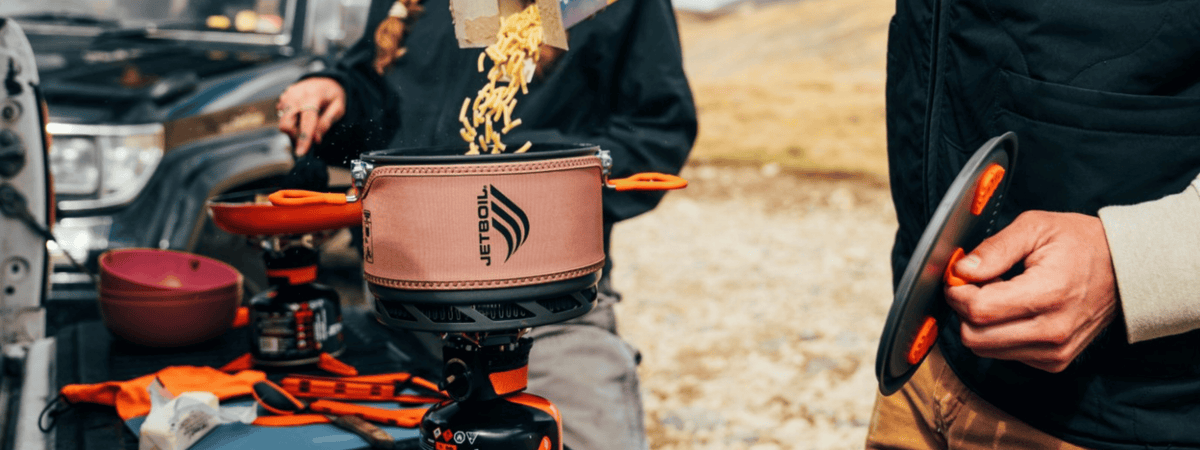
For the fast-and-light hiker who needs to boil water quickly for freeze-dried meals and a morning coffee, an integrated system like the Jetboil Flash S25 1.0L is consistently one of the camping stove best performers available. It's purpose-built for speed and efficiency, with FluxRing technology that maximises heat transfer and minimises fuel consumption. Weighing in as a compact, self-contained unit, it's an ideal camping stove portable enough for multi-day solo missions where every gram counts.

If you want the flexibility to do more than just boil water — simmering sauces, rehydrating meals, or cooking for two — the Jetboil TrailCook 1.2L delivers precision flame control alongside that same fast-boil capability. Its ceramic-coated non-stick pot, push-button ignition, and fold-flat silicone handle make it a noticeably more capable system without sacrificing too much in the weight department. For those regularly cooking for a partner or small group, the Jetboil TrailCook 2L steps things up further with greater capacity while retaining all the same smart design features.

Soto Windmaster
Where it gets really interesting is when you introduce a dedicated canister stove into the equation. The Soto Windmaster has earned a fierce following among serious hikers and alpinists for one very specific reason: wind performance. Most integrated systems struggle when a cold front rolls through or you're cooking exposed on a ridgeline.

The Windmaster's micro-regulator and 4Flex pot support are engineered specifically to hold their own in conditions that would have lesser stoves sputtering. If your adventures regularly take you into exposed alpine terrain or open bushland where wind is a constant companion, the Windmaster changes the equation entirely. For those who want a versatile, lightweight canister stove without the premium price point of the Windmaster, the Soto Amicus is a beautifully reliable hiking stove that handles a wide range of cookware and conditions.

The short answer to "what is the camping stove best for me?" is this: match the stove to the style of adventure. Integrated systems for speed and simplicity; canister stoves for versatility and cooking control; wind-optimised systems for exposed or alpine environments. Read our guide to portable camp stoves for Australian bushwalking to get a deeper breakdown of what suits different trip styles across our terrain.
How long does a camping stove fuel canister last?
This is the second most commonly asked question, and it's one that catches a lot of people out — particularly those new to backcountry cooking. The answer depends on three key variables: the size of your canister, the output of your stove, and how you're actually using it in the field.
As a general rule of thumb, a standard 100g isobutane-propane canister will last approximately two to three days for a solo hiker who is boiling water twice a day for meals and coffee. Push that to a more capable integrated system running at higher output, and you'll burn through fuel faster, but you'll also boil water more quickly, which partially offsets the difference. The Jetboil TrailCook 1.2L, for example, boils half a litre of water in just 2 minutes 10 seconds and yields around 12 litres of boiled water from a single 100g JetPower canister — impressive fuel economy that directly translates to fewer canisters carried over a long trip.

The way you cook also makes a significant difference. Running your stove at full blast to boil water, then immediately shutting it off, is far more fuel-efficient than keeping a gentle simmer going for extended periods. Using a lid on your pot, shielding your stove from wind, and pre-soaking freeze-dried meals can all reduce your fuel consumption meaningfully — sometimes enough to stretch a canister an extra day on a longer trip.
Cold temperatures are another important variable. Isobutane-propane mixes perform reasonably well in mild to moderate cold, but as temperatures drop towards zero and below, canister pressure decreases and output suffers. Stoves with a pressure regulator, like the Jetboil TrailCook systems, compensate for this by maintaining more consistent output throughout the life of the canister — not just when it's full and warm. The Soto Windmaster also features cold-weather regulation, making it a strong performer in conditions where a standard canister stove would start to fade.

For a two-person trip lasting three to five days, most experienced bushwalkers carry two 100g canisters as a baseline, with a third for longer or more demanding itineraries. If you're cooking more elaborate meals rather than just boiling water, plan accordingly. Check our Jetboil camping stove comparison guide to see specific fuel efficiency data across the range, which can help you plan your canister load more precisely.
Understanding both of these questions — what stove to choose and how far your fuel will go — is the foundation of smart camp kitchen planning. Get these two right and the rest tends to fall into place, whether you're out for a quick overnight or deep into a week-long traverse.

Leave a comment
This site is protected by hCaptcha and the hCaptcha Privacy Policy and Terms of Service apply.